
Simple Grilled Oysters with Garlic and Herb Butter
Buying Something That Is Still Alive
Almost everything else on the fishmonger's slab has already finished its story. An oyster has not. A live one is a small, sealed, working animal, and everything you need to know about its condition is written on the outside of the shell and in the air just above it. Learn to read those two things and you will rarely take home a disappointment.
Britain is well served here. Native oysters (Ostrea edulis) still come from the creeks and estuaries of Essex, Kent, Cornwall and the west coast of Scotland, while Pacific oysters are farmed from the Menai Strait round to Highland sea lochs. The trade is old, seasonal and deliberately small-scale, which means a good fishmonger will usually know the bed, the grower and the day the crop came off the water.
The Shell Test
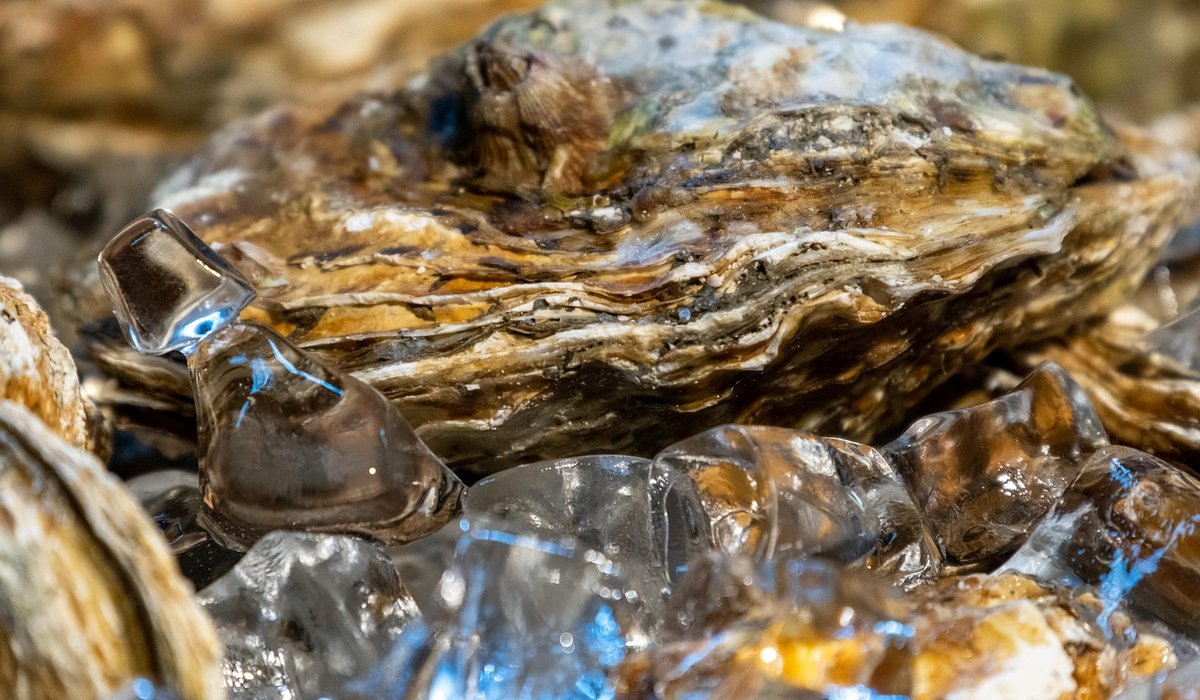
The single most useful check is also the simplest. A live oyster holds its shell shut. Pick one up and it should feel like a closed fist: firm, weighted, and slightly cool in a way that suggests cold water rather than a fridge that has been overworked.
- Tightly closed. Tap the shell against the counter or with another oyster. A live one will close smartly, or at least resist. If it gapes and stays gaping, put it back.
- Heavy for its size. That weight is the liquor inside — the oyster's own seawater, which is where most of the flavour lives. A shell that feels light and hollow has either leaked or dried out.
- Intact all over. Run your thumb around the rim. Cracks, chips and drill-holes in the hinge are all entry points. Even a small break means the oyster inside is probably dead.
- Lying flat, cupped side down. Oysters should sit on the slab with the deep half of the shell underneath, holding their liquor like a small bowl. If they are tipped over or swimming in a puddle of meltwater, leave them be.
- Not sitting in fresh water. Fresh water kills oysters. If the ice is melting into the display and the shellfish are bathed in it, that is a sign of a counter that is not being looked after.
The Nose and the Liquor
Lean in. A fresh oyster smells like a cold, wet rock at low tide — clean, mineral, briny, with a faint green note of cucumber or melon that is especially marked in natives. What you are looking for is the absence of anything else. Ammonia, sour milk, drains, or a heavy fishy tang all mean the oyster has been out of condition for a while, and no amount of lemon will fix it.
If the fishmonger is shucking to order, watch the shell as it opens. The oyster should be plump and glossy, sitting in its own clear liquor, with the mantle — the frilly edge — retracting when touched. Cloudy liquor, a shrunken dry body, or a shell that has been opened for hours and left to sit are all reasons to say no thank you.
What to Ask Across the Counter
Good fishmongers enjoy this conversation, so use it. A short, confident set of questions will tell you more than any label:
- Which coast or bed are these from, and when were they harvested?
- Are these natives or Pacifics? Natives are flatter, rounder, more coppery and more expensive; Pacifics are larger, deeper-cupped, saltier and crisper.
- Has the batch come with its registration document? Live bivalve molluscs sold in the UK must be traceable back to a classified harvesting area.
- Would you open one for me to look at? Any decent counter will.
- What would you drink with these? The answer tells you how much they have actually tasted the stock.
Natives, Pacifics and the Months with an R
The old rule about only eating oysters in months containing the letter R is half truth, half history. Native oysters spawn in the warmer months, turning milky and thin, and the traditional season runs from September to April. Pacifics are mostly grown as sterile triploids that never spawn, so they are sold year round — though they are at their best in the cooler months, when the water is cold and the flesh is firm and sweet.
This is also why oysters sit so comfortably in British coastal culture. Autumn and winter bring the oyster festivals, the harbour-side stalls, the pint of stout and a half dozen on a paper plate. Buying them from a fishmonger who knows the tide tables is part of the same pleasure.
Getting Them Home Without Losing the Plot
- Keep them cold and breathing. Transport in a cool box with ice, then store in the fridge at around 4–6°C.
- Cupped side down, covered with a damp cloth. Never in a sealed plastic bag, never submerged in tap water, never in a bowl of meltwater.
- Eat within three or four days. Shucked oysters should be eaten within twenty-four hours. Once opened, they are on the clock.
- Reject any that smell wrong when opened. Trust your nose at the sink as much as you did at the counter.
Buy small quantities, buy often, and buy from someone whose opinion you have learned to trust. That is the whole art of it — and it is a very pleasant one to practise.
LEAVE A COMMENT